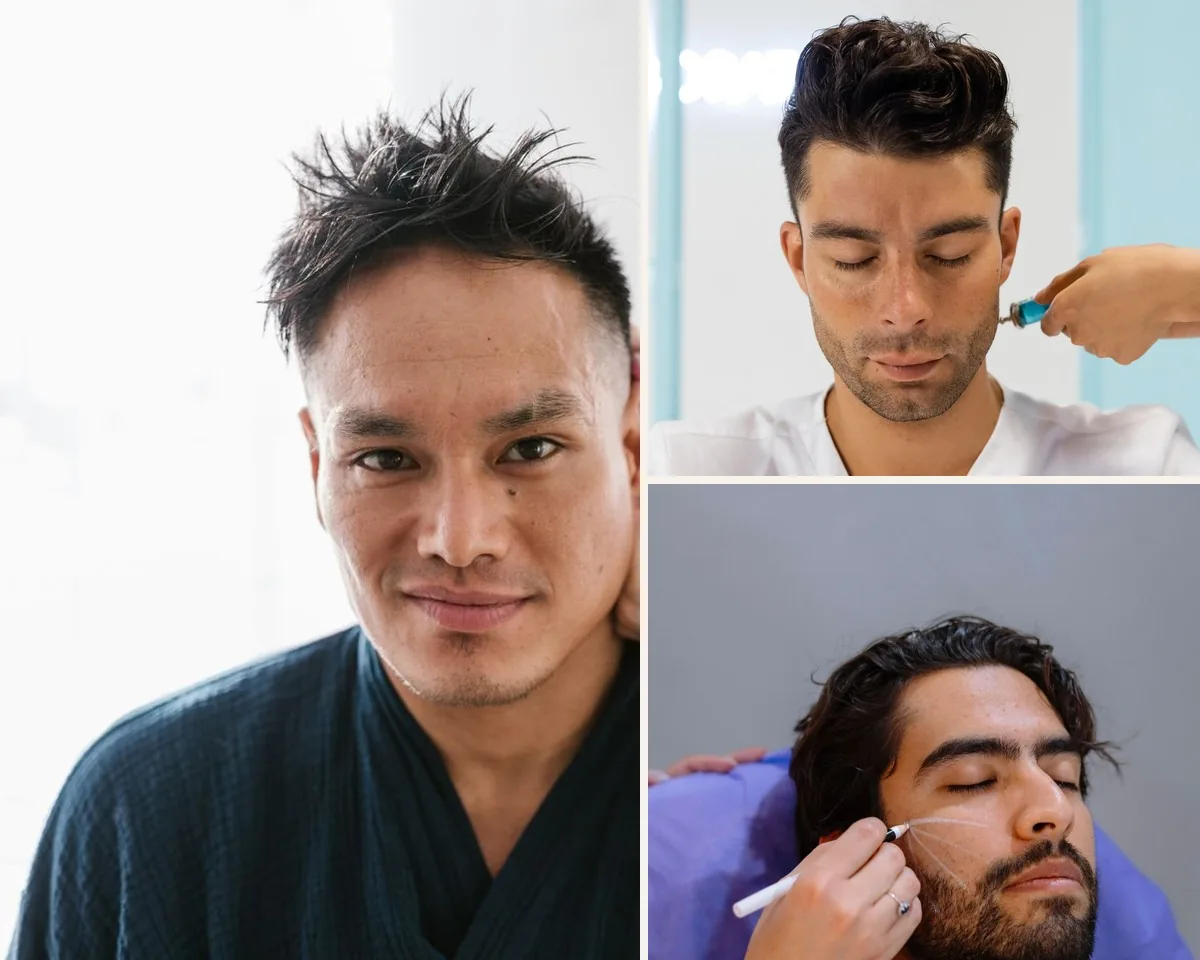
Recognising androgenetic alopecia
In men: temples that recede, then a thinning crown, with hairs getting finer before disappearing. In women: a widening parting, finer hair on top, the frontal hairline preserved. Family history points the way without settling it. It often starts between twenty and thirty in men, later in women, notably at the menopause.
What trichoscopy shows
The dermatologist’s magnifier reveals miniaturisation: hairs of very different calibres in the same place, follicles that now carry only fine down. It also rules out alopecia areata, inflammation or effluvium. A painless examination, repeated over the months, is used to measure the real effect of treatment.
Long-term treatments
Minoxidil, as a lotion or sometimes orally, prolongs the growth phase and thickens hair; it takes a few months to judge and is continued as long as you want to keep the benefit. In men, anti-androgen treatments may be prescribed; in women, care takes account of the hormonal context and any plans for pregnancy. These treatments are decided after the examination, with their benefits and side effects, and are not stopped without advice.
PRP, mesotherapy, exosomes: supporting treatments
Hair PRP, scalp mesotherapy and exosomes can accompany a main treatment in some patients, especially at an early stage, when follicles remain to be reactivated. They do not replace the main treatment and do not regrow hair on an area that has been smooth for a long time. The protocol, often three sessions then maintenance, is explained before starting.
And hair transplants?
A hair transplant is surgery: the clinic does not perform it, but the consultation helps establish whether the situation is suitable (enough donor area, stabilised alopecia) and when medical treatment is preferable, before or after. We refer you to a colleague if a transplant is the right option.
Follow-up to keep going over time
In the first months, treatment may come with a small shedding before regrowth. Standardised photographs of the scalp at three, six and twelve months set the starting point and show progress. The realistic aim is to slow progression and restore density where the follicle is still active.