How does laser hair removal work?
The laser emits light that the melanin in the hair absorbs: the heat produced reaches the follicle and weakens it. Only hairs in their growth phase are sensitive at each session, hence the need for several passes. We speak of durable hair reduction: regrowth becomes finer, sparser, even absent on well-responding areas, but partial regrowth remains possible, notably with hormonal changes.
Which areas, for women and men?
We treat the face (upper lip, chin, cheeks), underarms, bikini line, legs, arms, back, shoulders and chest in men, the beard line or the nape. Areas are chosen with you, with settings specific to each. In men, hair removal of the back or nape and management of ingrown hairs are frequent requests.
How many sessions, and at what rhythm?
The number of sessions depends on the area, the density and colour of the hair, the skin type and hormones. Several sessions are generally needed, a few weeks apart (closer on the face, more spaced on the body). The exact number is defined after the assessment, then adjusted according to the response observed. Maintenance sessions may be useful.
Before the session
A prior consultation assesses skin type, history and any contraindications before starting the protocol. During the protocol, wax and epilators are avoided to keep the hair in place; the area is shaved before the laser. Precise instructions are given at the consultation.
How a session goes and aftercare
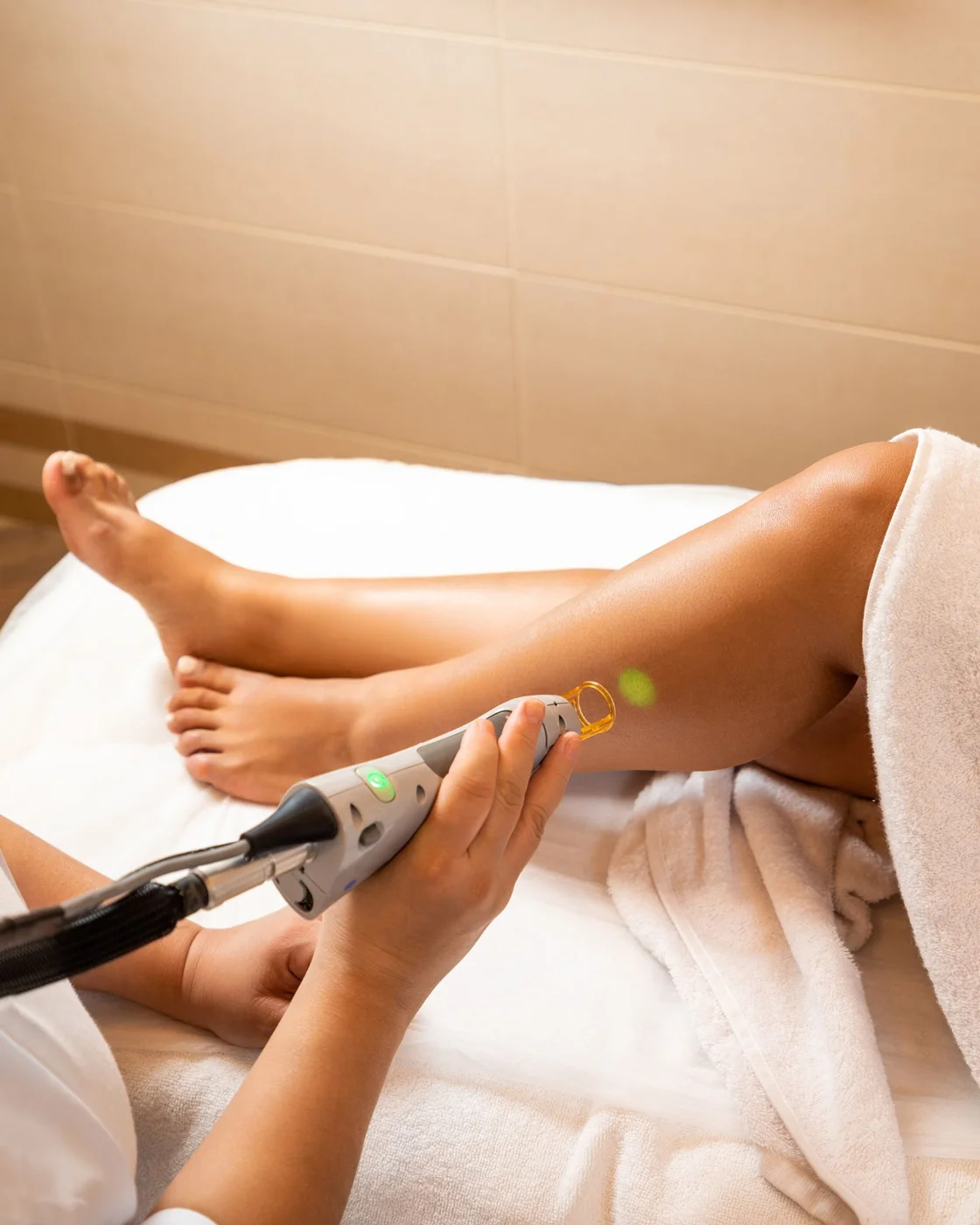
The area is shaved and cleaned; goggles protect the eyes. The laser is passed zone by zone with skin cooling, and the sensation is described as tingling or brief heat. Slight redness and small swelling around the hairs are common and disappear within hours to days. A soothing treatment is applied at the end of the session.
Sun, tan and precautions
Laser is for untanned skin: avoid sun and UV before and after the session, and apply high sun protection, especially in Marrakech, where people readily start in autumn or winter. Report photosensitising treatments, recent isotretinoin treatment, active herpes, damaged skin or pregnancy: laser hair removal is postponed during pregnancy, as a precaution.
Olive and dark skin: why the choice of laser matters
The darker the skin, the more light it absorbs and the greater the risk of burns or marks if the laser is not suitable. The clinic's Nd:YAG (Fotona SP Dynamis Nx Line), with a deeper wavelength, treats dark skin types more safely, thanks to individualised settings and built-in cooling. This is a medical skill: a skin type that has not been assessed is a risk.
Why laser hair removal in a dermatology practice?
Excessive or suddenly appearing hair growth may have a cause to look for (hormonal, for example polycystic ovary syndrome, or drug-related). The dermatologist examines the skin and history before lasering, treats ingrown hairs, folliculitis and any complications, and chooses settings according to skin type. Laser is a medical procedure, not a mere comfort treatment.
Mistakes that make laser hair removal fail
Exposing yourself to sun or UV between sessions (the laser is then postponed, and the risk of marks rises), waxing or using an epilator during the protocol (the hair must stay in place for the laser to work), stopping the series too early, or neglecting a hormonal cause that maintains regrowth. Respecting intervals and instructions is the key to the result.
Between two sessions
In the weeks that follow, treated hairs fall out gradually (so-called false regrowth). Shave if needed, without waxing. Moisturise the skin, protect it from the sun and avoid irritating products right after the session. If an area heats up, swells strongly or forms scabs, tell the clinic.
Where to have laser hair removal in Marrakech?
At the Skin & Aesthetic Clinic, in Guéliz, with Dr Sara Zahid, dermatologist, by appointment, in French, English or Arabic. A consultation comes before the first session; a detailed quote is given before any procedure, with no single displayed price.