What is alopecia areata?
It is an autoimmune disease: the immune system mistakenly attacks the hair follicles, which temporarily stop producing a hair without being destroyed. That is why hair can grow back, even after years. It is not always known why it occurs; a family background, an associated autoimmune disease (thyroid, vitiligo) or an emotional shock are sometimes found, but often no cause appears.
How to recognise it
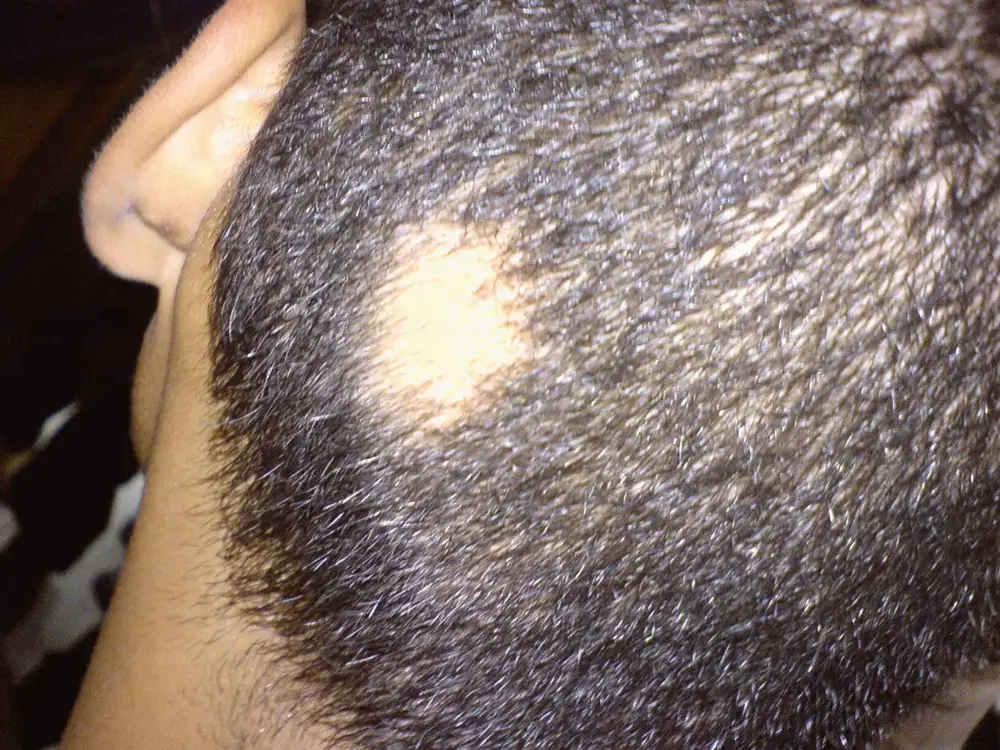
One or several round, clear-cut patches, without redness or scaling, sometimes with small “exclamation mark” hairs at the edges. It can affect the beard, eyebrows, eyelashes, nails (small pits) and, in extensive forms, the whole scalp or body. On trichoscopy we see yellow dots and broken hairs that confirm the diagnosis without a biopsy in most cases.
What we look for at the examination
We check the extent, the duration, nail involvement and associated diseases, with a targeted blood test if needed (the thyroid in particular). We rule out other causes of patches: ringworm in children, lupus, lichen, traction on the hair, scarring alopecia. The exact diagnosis changes the treatment.
Treatments, depending on the extent
For a single patch, we can observe, since spontaneous regrowth is common, or treat with topical corticosteroids or local corticosteroid injections, repeated at regular intervals. For more extensive forms, other treatments exist, local or general, chosen with you according to age, duration and what the condition costs you day to day; severe forms sometimes call for an additional specialist opinion. Wigs, hair prostheses and eyebrow make-up also have their place, without shame.
Course: what to expect
Alopecia areata is unpredictable: a patch may regrow within a few months, relapse or spread. Regrowing hair is sometimes white or fine at first before regaining its colour. Follow-up serves to adjust treatment and to judge on photographs taken in the same conditions, rather than on the impression of the moment.
Alopecia areata in children and teenagers
It is not rare. We favour gentle, low-pain treatments, avoid multiplying injections, and take the time to reassure the child and parents, notably about school. Paediatric dermatology is part of the clinic’s consultations.
Living with alopecia areata
The psychological impact is real, even for a small patch. Talking about it in consultation is part of the care: support can be coordinated if needed and we explain how to cover or camouflage an area while waiting for regrowth.