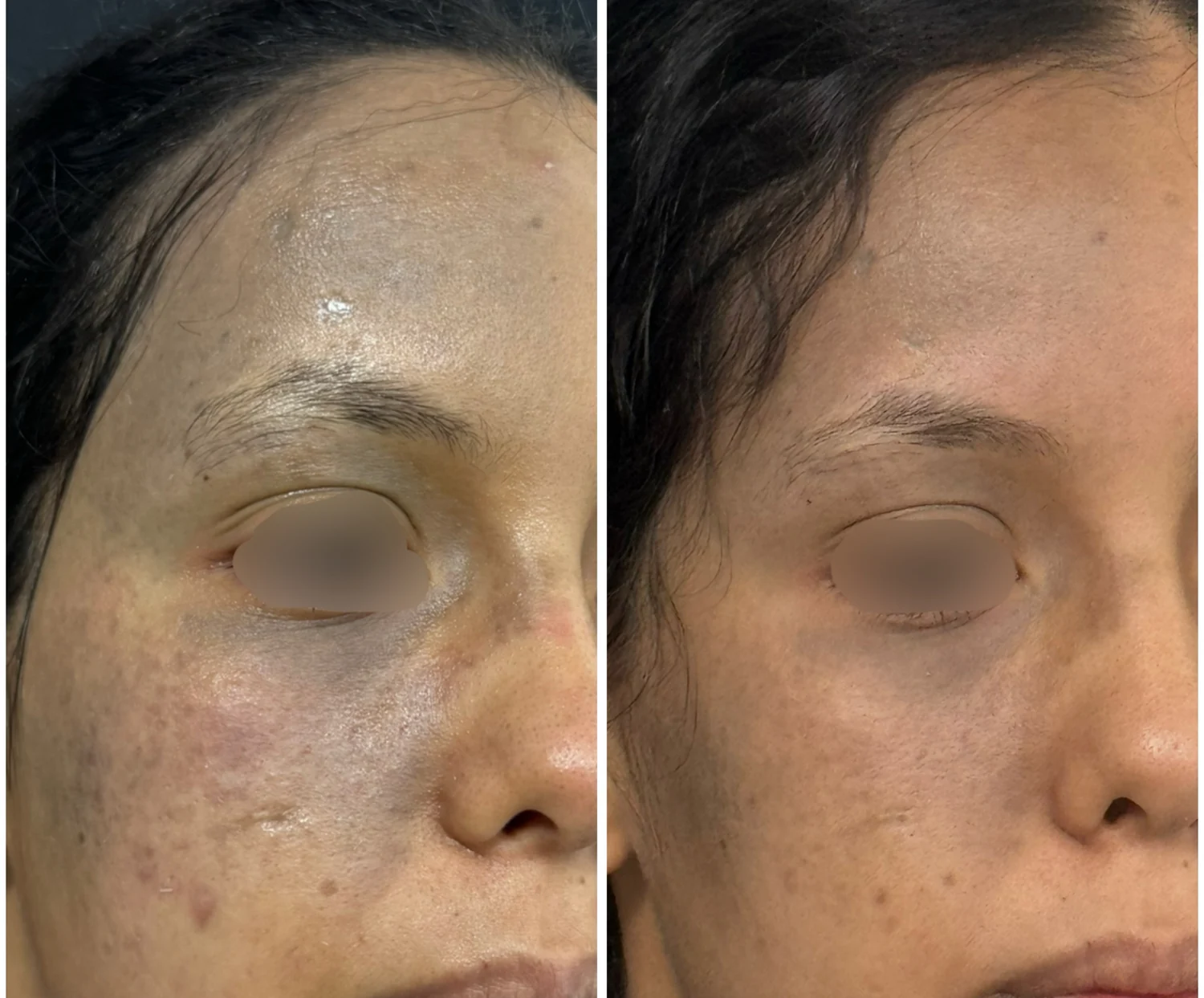
What is a nevus of Ota?
A bluish, grey or brown pigmentation, due to pigment cells located in the deep dermis. It generally affects one side of the face, in the area of the eye, temple, cheek, forehead or nose, and may reach the white of the eye. It is present at birth or appears in childhood or adolescence, and is more common in dark and Asian skin. It is benign, but does not disappear on its own.
What is a nevus of Hori?
Nevus of Hori (or acquired Ota-type nevus) shows as small brown-grey spots, often on both sides of the cheekbones, appearing in adulthood, more often in women. It looks like melasma, with which it is frequently confused, but does not respond to melasma treatments. Only a dermatological examination, sometimes with dermoscopy, can tell them apart: hence the value of consulting before piling on creams and peels.
Why do they not go away with creams?
The pigment lies in the deep dermis, beneath the layer that lightening creams reach. Depigmenting products and superficial peels therefore have little effect, and some can irritate the skin. Lasers with very short pulses, which pass through the surface and break up the deep pigment, are the reference treatment.
Treatment with Q-Switch and picosecond laser
The clinic has the StarWalker MaQX laser, which combines Q-Switch and picosecond pulses across two wavelengths (1064 and 585 nm). The laser passes through the epidermis without damaging it and breaks up the pigment in the dermis, which immune cells then clear. The choice of wavelength and settings depends on the depth of the pigment, the colour of the spot and the skin type.
How many sessions, what results?
Several sessions are needed, often more than five, spaced several weeks apart (generally one to three months), to let the skin recover. Improvement is gradual: the spot lightens, sometimes markedly, sometimes without total disappearance. The result varies with the depth of pigment, the area and the skin; comparison photos allow progress to be followed. Improvement is assessed with you, session after session.
Olive and dark skin: a treatment that takes experience
In olive and dark skin, where these nevi are common, the laser can cause a temporary brown mark (post-inflammatory hyperpigmentation) or, more rarely, a light mark if badly set. Dr Zahid is trained in dark skin types: cautious settings, longer intervals, strict sun protection, skin preparation, and a test on a small area if needed.
Eye involvement: an ophthalmology opinion
When a nevus of Ota affects the white of the eye, follow-up by an ophthalmologist is advised, as it can come with pigmentation of the eye and, rarely, raised eye pressure. This monitoring is independent of skin treatment and the dermatologist refers you.
Precautions and contraindications
Avoid sun and UV before and after sessions and apply sunscreen. Laser is postponed in case of tanned or damaged skin, pregnancy or a tendency to keloid scars; report photosensitising treatments. After a session, the skin is red for a few hours to a few days, sometimes with small scabs.
Why a diagnosis before laser?
A brown or grey spot on the face is not always benign: a nevus of Ota, a nevus of Hori, melasma, a lentigo or, more rarely, a lesion to monitor are treated differently. The dermatologist examines the spot, with dermoscopy if needed, before any laser; it is not a comfort treatment but a medical procedure.
Where to treat a nevus of Ota in Marrakech?
At the Skin & Aesthetic Clinic, in Guéliz, with Dr Sara Zahid, dermatologist, by appointment, in French, English or Arabic. A consultation precedes the first session; a detailed quote is given before any procedure, with no single displayed price.